
F&B Services Index: July 2026 – Stabilisation Signals Amid Persistent Headwinds
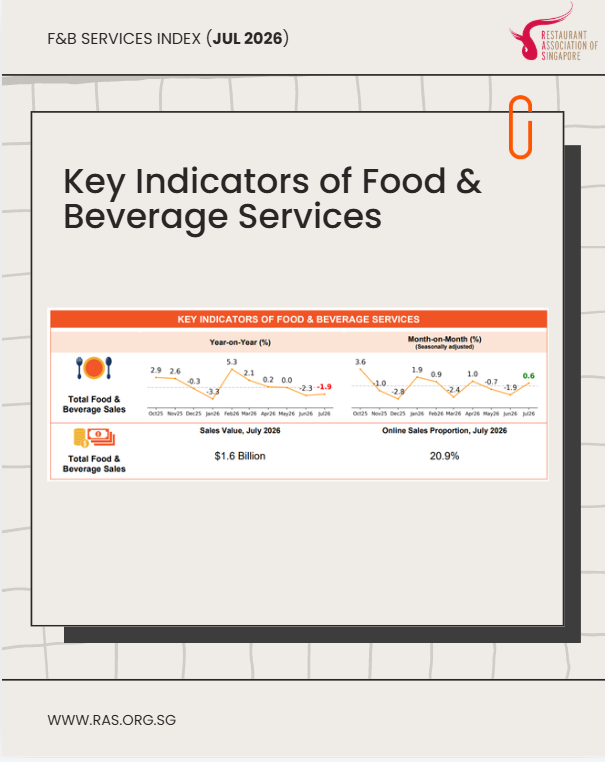
The latest Food & Beverage Services Index data for July 2026, released by the Singapore Department of Statistics, offers a measured dose of encouragement: the year-on-year decline has slowed to -1.9%, an improvement from June's -2.3%. Total F&B sales reached $1.6 billion—up $100 million from the previous month. But the headline masks a deeply segmented market where winners and losers are increasingly divergent, and where cost pressures continue to squeeze the middle.

The Numbers: Reading Between the Stabilisation
At face value, July shows a softening of the downward trend. Month-on-month, adjusted for seasonal factors, sales were flat to slightly positive at +0.6% compared to June. For an industry in contraction, a pause is noteworthy.
But segment-level data reveals a more complex picture:
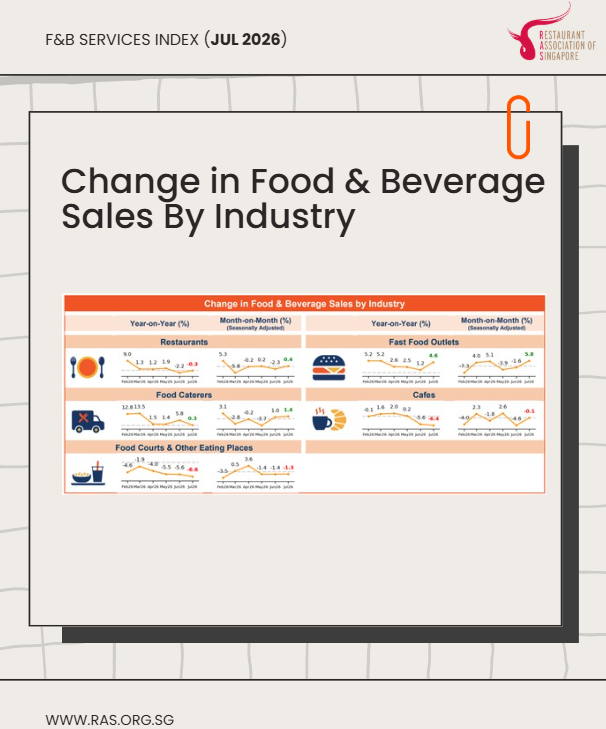
Fast Food Outlets remain the category's bright spot, posting +4.6% year-on-year growth—the strongest performance across all F&B segments. On a monthly basis, they accelerated further with +5.8% growth, suggesting that price-conscious consumers are voting with their wallets for value-oriented dining.
Food Caterers held at +0.3% year-on-year, though they've retreated significantly from June's robust +5.8%. This category—which includes corporate, event, and institutional catering—appears to be stabilising but has lost momentum. The question for caterers: Is the retreat a seasonal normalisation, or does it signal softer demand for discretionary events and corporate dining?
Restaurants, the sector's largest segment by brand count, improved slightly from June's -2.2% to -0.3% year-on-year. Month-on-month, they posted +0.4% growth, a fragile recovery that suggests some operators are finding their footing. But the YoY decline—however modest—indicates that despite efforts to stabilise costs and drive traffic, dining remains discretionary for many Singaporeans.
Food Courts & Other Eating Places and Cafes both deteriorated: food courts plunged to -6.6% (from June's -5.6%), and cafes sank to -6.4% (from -5.6%). These segments—anchors of Singapore's food culture and accessible price points—are struggling most acutely. The decline suggests that even budget-conscious segments are feeling the pinch, likely from a combination of elevated rental costs, manpower expenses, and reduced foot traffic.
What Online Sales Tell Us
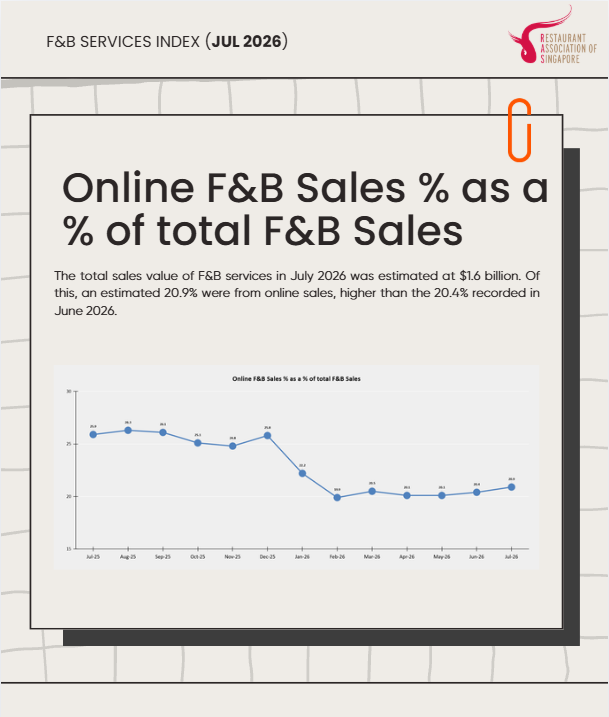
Online channels now account for 20.9% of all F&B sales, up marginally from June's 20.4% but stable over a five-month range around 20%. For operators, this represents a matured channel—no longer a growth play, but a baseline operational necessity.
The plateau in online share suggests that the real battleground has shifted from adoption to margins. Food delivery platforms, once seen as a route to incremental revenue, now operate on thin commissions and contribute to overall profitability challenges. The fact that online sales remain steady while overall sales contract indicates that some operators are successfully converting customers to digital channels—but at potentially lower unit economics.
Segment Divergence: The Real Story
The July index reveals an industry increasingly split into tiers:
- Premium positioning (fine dining, casual upscale cafes) struggles with discretionary spend; consumer behaviour is retracting toward value.
- Value-driven fast food thrives, capturing consumers trading down from mid-priced casual dining.
- Mid-market restaurants and cafes squeeze in the middle, absorbing cost pressures while facing margin compression from both directions.
- Institutional and event catering remains soft, dependent on corporate spending and event volume that remain below pre-pandemic norms.
This isn't temporary cyclicality. It reflects structural shifts: a tightening consumer wallet, elevated fixed costs (particularly rent), and manpower constraints that make wage pass-throughs difficult.
The Cost Pressure Reality
The stabilisation in July's YoY decline should not distract from a sobering truth: the sector remains in contraction even as month-on-month figures show stabilisation. This pattern—declining sales against a backdrop of persistent cost pressures—is precisely the financial fragility that RAS highlighted in its Budget 2026 advocacy submissions.
Operators face a trilemma:
- Rental costs remain fixed and largely immovable; landlords are not rolling back renewal hikes.
- Manpower costs continue to rise via the Progressive Wage Model, an important labour policy but one that operators absorb in full without proportional revenue growth to offset it.
- Consumer demand is inelastic downward—pricing power is limited when discretionary dining is the first item to cut from household budgets.
The result: thin margins, reduced investment in upskilling and innovation, and an increasing number of closures among small and independent operators.
The Bright Spot: Fast Food's Resilience
Fast food's +4.6% YoY growth (and +5.8% month-on-month) stands in sharp contrast to the broader sector. This segment's success reflects a few dynamics:
- Menu accessibility: Low price points insulate fast food from discretionary cutbacks; it remains affordable convenience.
- Operational efficiency: Chains in this category typically have tighter cost control and economies of scale that smaller operators lack.
- Brand equity: Well-known chains benefit from brand loyalty and marketing reach that independent operators cannot match.
For RAS members in other segments, fast food's resilience is instructive: it suggests that value and efficiency will define winners. Operators should critically review their cost structure—from labour deployment to menu engineering to rental footprint—with an eye toward delivering value to price-sensitive consumers.
What's Ahead?
July's data shows stabilisation, not recovery. The YoY decline has slowed, month-on-month figures are flat to slightly positive, and total sales value is incrementally up. But each data point comes with caveats:
- Stabilisation can reverse if consumer confidence weakens further.
- The segment split suggests winners emerging, but not at the expense of sustained broad-based recovery.
- Cost pressures remain unrelieved; margin improvement requires either volume growth (not yet visible) or cost restructuring (operationally difficult without trade-offs).
For the industry and its members, the message is clear: this is a reset moment, not a cyclical trough. Operators who adapt—by rethinking pricing, streamlining operations, and investing in digital channels and efficiency—will survive and position for growth. Those waiting for demand to return to pre-2024 levels may not have that luxury.
RAS remains committed to advocating for structural support—including progression of wage credit subsidies, cost predictability through rental policy interventions, and continued support for enterprise development—that will give operators the breathing room to manage this transition and emerge stronger.
For more detailed data, see the Food & Beverage Services Index report from the Singapore Department of Statistics.